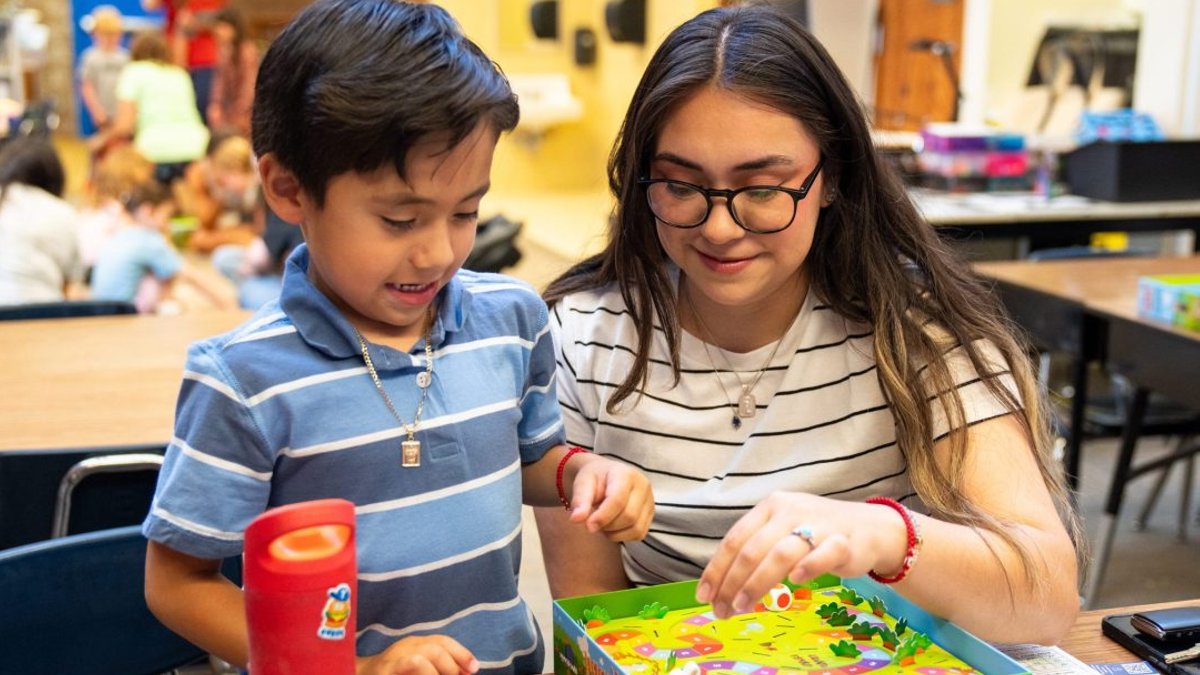
Utah is betting on parents to close a widening gap in early math skills. At Plymouth Elementary School just outside Salt Lake City, Clarence Ames, who leads research for the Utah STEM Action Center, asked a room of 15 parents and their young children if anyone had ever said, “I’m not a math person.” Most hands went up.
Making Math Less Scary for Parents
Ames, an early math evangelist, said he often sees deer-in-the-headlights looks when he tells parents they should do math with their kids. He listens to their trauma stories, a shared experience for many adults. The STEM Action Center launched MILO & Friends in September 2022 to encourage parents to start math conversations before kindergarten. The program partners with Granite School District’s family engagement program, which has hosted these sessions for three years.
Parents often believe they are unqualified to teach math and should leave instruction to teachers once children start school. Ames argues that practicing math before school is “super important” and that parents are a child’s best first teacher. To make this accessible, the group evaluated hundreds of games before choosing Happy Bunny. The game is straightforward enough that parents and kids can’t go wrong, Ames said.
Why Early Math Skills Matter
Providing a strong math foundation is essential to cutting the achievement gap between rich and poor families, researchers say. By kindergarten, Black and Hispanic children, as well as those from low-income families, are disproportionately represented among those with low math skills. Stanford University professor emerita Deborah Stipek noted that for anyone serious about reducing the achievement gap, starting before children enter school is clear.
Research shows that children who develop early math abilities—like counting and basic calculations—perform better in math throughout their school years and are more likely to pursue higher education. Those with stronger math skills during their school years also tend to earn higher incomes as adults. This finding led Clarence Ames to connect with a Washington state initiative five years ago that promoted early math learning through a public outreach campaign targeted at parents. Since Ames lacked funding for a similar promotional effort, he and his team created MILO & Friends, a hands-on program designed to engage parents directly.
How Parents Can Practice Math at Home
Studies have shown that math-related board games offer an effective, easy way for parents to approach the subject with their kids. At Plymouth Elementary, the parents played Happy Bunny. It is a game of bunny versus farmer where players roll a die to move the bunny along a garden path. Carrots are embedded in slots, some bitten and some whole. Players harvest the number of carrots listed on the colored square they land on, sorting bitten ones into the bunny’s pile and unbitten ones into the farmer’s pile. Once the bunny reaches the end, players compare carrot piles to see who has more.
While the game may appear straightforward, Ames explains that it incorporates several key math concepts. Aligning the die’s color with the board’s color introduces abstract thinking. Moving to the next blue square, not just any blue space, reinforces sequencing. Pulling the number of carrots indicated on a square teaches children to recognize numbers symbolically. Counting those carrots helps them grasp cardinality, while dividing them into bitten and unbitten piles teaches categorization and set differentiation.
For parents, math can feel harder than reading. Reading to a child requires only opening a book, but math requires a little more thought to ask questions. After attending a session, Katie Bearnson planned to do more math-focused activities with her son Bentley before he starts kindergarten. She and her other son, Bradley, played the game at the event. After a half hour, the families left with free copies of the game and laminated math conversation cards on a key ring.




Leave a Reply