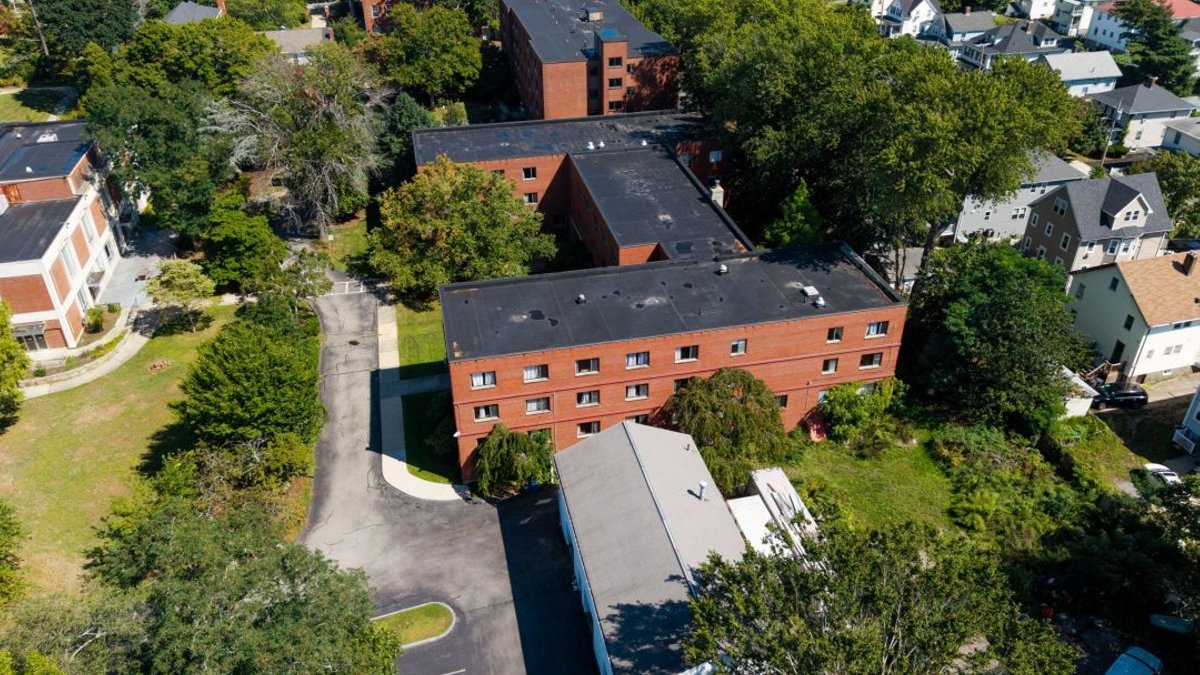
Vegetation up to waist height pushes through the cracks of the tennis courts, while ivy wraps the sealed doorway of a former red-brick women’s residence hall. Canada geese wander across the baseball diamond, and wild turkeys scratch in the surrounding brush.
Eastern Nazarene’s Financial Collapse
These natural forces are taking back the remnants of Eastern Nazarene College, which shut its doors last year after enrollment collapsed and debt surged to an unsustainable $18 million.
The campus joins a growing list of defunct higher-education institutions that sit idle—some for decades—as localities debate future uses and governing boards grapple with creditor repayments.
“I don’t want to see it wasted,” said Donna Glynn, a teacher who has lived for half a century across the street from Eastern Nazarene in the 100,000-person city just south of Boston. “We could have nice, new, clean housing.”
The path toward reusing the site for housing has twisted repeatedly, prompting Glynn to become emotional as she described the saga. The former college remains unused.
“Why would you throw this resource away?” she asked, nodding toward the former college.
Housing Demand and Development Proposals
According to mortgage lender Freddie Mac, the United States must construct roughly 3.7 million homes to satisfy demand. State officials estimate that Massachusetts alone will need at least 222,000 additional units by 2035, and the U.S. Chamber of Commerce together with the American Enterprise Institute reported that Quincy is short about 4,400 homes.
Eastern Nazarene appears to be an ideal location for new construction. It sits within a residential district and enjoys proximity to public transit. Prior to its final commencement ceremony, the institution signed a deal with a private-equity and development firm owned by an alumnus, which reportedly envisioned more than 600 housing units on the 27-acre property.
Quincy’s mayor, however, deemed that quantity excessive. After the original agreement collapsed, he suggested the city purchase the site for roughly $23 million and develop a smaller number of units than the developer had proposed. In June, the city council dismissed the proposal, citing cost concerns.
The discussion has grown contentious and political, and none of the parties, the developer, the mayor, the three council members who backed the plan, the college’s transition board, or its real-estate lawyer, have answered inquiries.
Expert Insights on Conversion Obstacles
“It seems an easy case to make” to turn closed college campuses into housing, said Christian Koulichkov, director of real-estate brokerage at Hilco Global, noting he was speaking in general terms and not specifically about Eastern Nazarene or Quincy. “It makes sense just from a need perspective. The one commodity we have too little of in this country is housing, and affordable housing to boot.”
Adapting former campuses for residential use is not without obstacles. Many sites lack zoning approval for housing, and numerous closed institutions were left in poor condition. Their structures are often aging, fail to meet accessibility codes, and dormitories typically feature shared bathrooms and dense floor plans that are difficult to convert into independent apartments.
Even as the wave of college closures accelerates, Huron Consulting Group projects that 442 private, nonprofit colleges and universities could shut down or be forced to merge within the next decade, few governing boards have contingency plans for a possible shutdown. Communities generally do not anticipate such an outcome, so they make little preparation for managing an abruptly vacant campus.
Kurt Wheeler, mayor of Cazenovia, New York, encountered this scenario when the 200-year-old Cazenovia College defaulted on $25 million of debt and closed in 2023, leaving a deserted campus in the village center.
When officials surveyed other towns for examples of successful repurposing, Wheeler said, “We could not find a successful example, especially in small towns.” He added, “So we said, ‘We’re going to be the first.’ Because this problem is not going to go away.”
The village commissioned a feasibility study and revised the property’s zoning to attract developers; a consortium of local investors then purchased many of the buildings to transform them into a new “town square” featuring housing and mixed uses.
“If we don’t want this really awful outcome of the weeds and the falling-apart buildings, we all have to be a little bit flexible,” Wheeler remarked.
Nevertheless, numerous other towns with shuttered colleges remain stuck with overgrown grounds and deteriorating structures.
The local paper described the abandoned Limestone University campus in South Carolina as a “field of weeds.” The school closed last year under $38 million of debt and is entangled in creditor disputes, a lawsuit from former staff seeking back wages, and claims from alumni demanding refunds for unprovided classes.
Virginia Intermont College has sat empty for 12 years, even after a Chinese firm acquired it. In 2024, four of its buildings were destroyed by a large fire, and the debris has yet to be cleared, while many of the remaining structures have been vandalized.
Neighborhood opposition can also delay redevelopment. Red signs reading “Save our Neighborhood” appeared on lawns surrounding the former Eastern Nazarene, placed by opponents of the initial high-density plan.
“I’d love to keep it as it is”, as a tranquil, park-like setting, said Lauren Hickey, who walks her dog, Charlee, through the arboretum-designated grounds named for a former botany professor.
Successful Conversions Across the Nation
Some municipalities have succeeded in moving forward with housing projects on former campuses. For example, a developer intends to erect 165 homes on the 60-acre former Holy Names University site in Oakland, California, which closed in 2023. A nonprofit is creating dozens of apartments for former support-care youth on the former Dana College campus near Omaha, which shut down in 2010, and is also proposing senior housing there. Low-cost units have been built on a closed Johnson & Wales University branch in Denver, and roughly 160 upscale senior-living apartments now occupy part of the former Newbury College property near Boston.
Housing conversions are also being considered for more recent closures. Alumni, residents, and local nonprofits have teamed up to develop affordable housing on the 275-acre former Simon’s Rock campus of Bard College in western Massachusetts, which the college divested last year. Officials near Trinity Christian College, which closed this spring near Chicago, are urging the new owner to sell portions of the site for senior-housing projects.





Leave a Reply