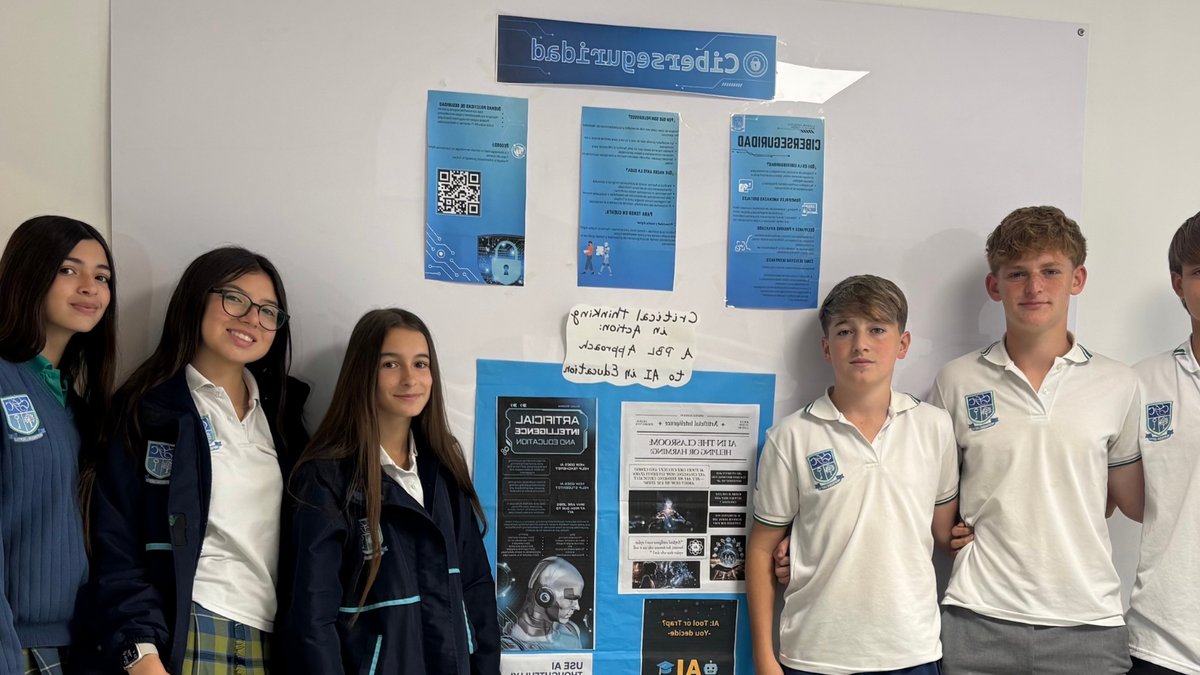
Cambridge Global Perspectives gave six IGCSE students at Grilli Canning College in Buenos Aires a platform to explore whether artificial intelligence is a classroom aid or a cognitive trap. The team—Tobias Alvarez Martin, Lara Benitez, Emma Gabrielli, Luc Gill, Valentino Navarro and Lara Waizer—submitted a project titled “AI and education: tool or trap?”
Student-led inquiry into AI
The group combined global data, national policy reviews and a survey of teachers and peers to map AI’s impact on learning. Their research examined regulation in China, the United States, Spain and Argentina, then distilled findings into a presentation for the Cambridge Global Perspectives Fair.
At the fair, 37 schools from Latin America and the Caribbean joined a live-stream that attracted 425 online attendees. The students not only shared statistics but also offered concrete, responsible strategies for integrating AI tools into classroom practice. Participants asked questions about ethical use, data privacy and how to balance automation with critical thinking.
Why AI sparked debate
“Using AI in the classroom is a controversial issue,” said Emma Gabrielli. Her teammate Lara Benitez added, “There are plenty of teachers that don’t allow us to use AI in class, but there are some exceptions too… this inspired us to talk about AI in a presentation and show it to the other teachers, maybe to open their minds about the topic.”
When the team surveyed classmates, 82.8% reported using AI for homework. Specifically, 43.1% said they “sometimes” relied on AI, 25.9% “often” did so, and 13.8% claimed they “always” used AI tools for assignments. The responses illustrated a spectrum of dependence, from occasional assistance to full-time reliance.
Related Post: Cambridge Checkpoint aids student exam readiness
Tobias observed that many peers complete work with AI rather than thinking independently. Luc Gill noted, “I think it’s a very useful tool. It helps you to do a lot of things, like research or answer your curiosities. However, it can also be a trap because people can be too dependent on it, decreasing their thinking capacity.”
Teacher responses echoed the split view: 19% of educators said they “frequently” see students depend on AI for completing work, while others reported using AI to generate support material. Some instructors expressed optimism about personalized tutoring, whereas others warned of plagiarism risks.
To broaden their perspective, the group examined how China, the United States, Spain and Argentina regulate AI in schools. After watching a video from a Chinese classroom that showcased AI-driven lessons, their Global Perspectives teacher, Natalia Pieres, remarked that the experience demonstrated how far Argentina still has to go in both implementation and legislation.
Valentino described how gathering peer data made him more aware of his own study habits, while Lara Waizer explained that presenting findings boosted her confidence in public speaking. The collaborative nature of the project also supported teamwork, as each member contributed a specific analytical angle, statistics, policy, pedagogy or ethical considerations.




Leave a Reply