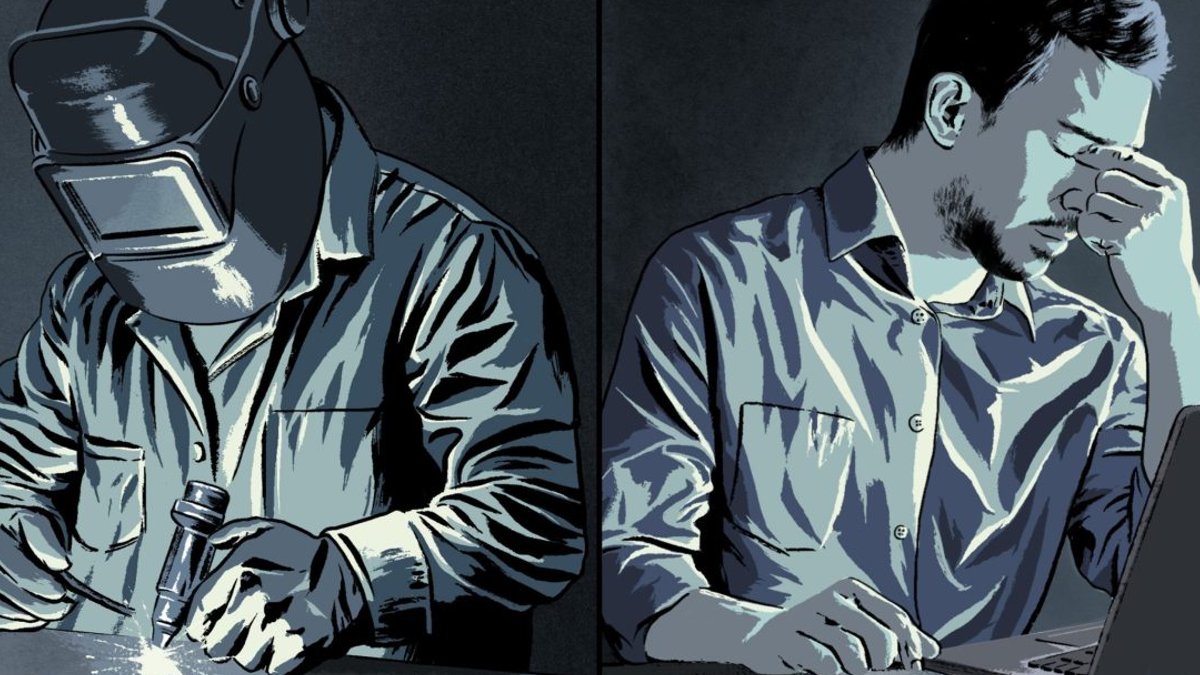
Keon Davis saw artificial intelligence tools take over parts of his summer internship in marketing, handling tasks like writing outreach emails and analyzing consumer data. When he graduated from the University of Wisconsin-Madison in May 2024, he had already decided to leave the field behind. Instead of entering marketing, he joined Teach for America and now teaches third grade at a New York City charter school.
This shift illustrates a broader trend among young workers and recent graduates who believe AI will eliminate their jobs. Many are turning away from computer science, business, and other fields vulnerable to automation toward roles requiring human interaction or hands-on skills. A Pew Research Center survey from August showed that 73% of adults under 30 expect AI to reduce job opportunities, up from 61% two years earlier.
Research supports these concerns. A Stanford Digital Economy Lab study examined employment changes between November 2022 and June 2026. Workers aged 22 to 25 in AI-exposed roles—such as customer service and software development—experienced a 19% drop in hiring compared to those in less-exposed jobs, like nurses’ aides and maintenance and repair workers. The decline persisted even after accounting for broader economic factors.
AI’s Immediate Job Threat Sparks Career Shifts
Some economists suggest companies may be using AI as a pretext for downsizing after pandemic-era hiring surges. For workers like Davis, however, the threat feels immediate. His new career in teaching requires trust-building, adaptability, and emotional intelligence. “Stuff like that cannot be automated,” he said.
Davis is not alone. Enrollment in computer science programs has fallen while health professions and teaching programs see increases. At Teach for America, applications rose 43% from 2022 to 2025. Teachers of Tomorrow, an alternative certification program, saw a 30% jump in applications in 2026 compared with 2025, with many applicants citing AI-related job fears as their reason for switching fields.
Apprenticeships for hands-on trades have also grown. Federal data shows a 20% increase in young workers under 24 enrolled in registered apprenticeships between 2022 and 2024. Trade schools market these roles as “AI-proof six-figure jobs,” emphasizing demand for electricians, HVAC technicians, and carpenters—fields where job growth outpaces the national average by two to three times.
Trades Boom as AI-Proof Six-Figure Alternatives
At Rosedale Technical College in Pittsburgh, enrollment climbed 50% in two years, with interest calls up 80%. Many new students are former white-collar workers, including Kevin Brough, a 34-year-old software developer laid off in May 2024. After observing AI advancements, he enrolled in the college’s automotive technology program. “I never thought I’d be changing from software development, but here I am,” said Brough.
Yet the transition is not without challenges. Blue-collar work demands physical effort, long hours, heavy lifting, and unpredictable schedules. Meagan Acevedo, a 33-year-old former human resources manager, now starts her electrician apprenticeship at 5:30 a.m. daily. She lifts 75-pound spools of wire and works under tight deadlines, though her pay, $23 an hour plus full benefits including employer-funded health insurance and a pension, provides stability. In New York, electricians earn a median $38 an hour, with public works projects paying up to $126.
Davis’s decision was partly influenced by his early exposure to AI during his junior year at the University of Wisconsin-Madison. He first used ChatGPT in November 2022, when it launched, and found it efficient for tasks like drafting emails or analyzing data. As AI tools improved, he grew uneasy about how easily his skills could be replaced. So he went back to school for a degree that required more science, figuring those skills would be harder to replace.
Not All Transitions Guarantee Stability
Not every transition has been smooth. Cassie, a 31-year-old public relations assistant in Tampa, Florida, switched from journalism to criminal forensics after witnessing AI tools displace staff writers. She graduated in December 2023 but has struggled to secure a forensic technician role. Police departments prioritize veterans and sworn officers, even without relevant degrees, leaving her degree less valuable than expected. “I overestimated how much better the workforce would be with a degree in a science,” she said.
Workers Adjusting to AI-Driven Career Shifts Face Practical and Policy Challenges
Physical labor presents its own hurdles for those transitioning into trades. Meagan Acevedo, a former human resources manager, now begins her electrician apprenticeship at 3 a.m. to meet early job site requirements. The demands of lifting heavy equipment and adhering to tight schedules contrast sharply with the flexibility of her prior office-based work, though the trade offers higher earnings and clearer long-term prospects.





Leave a Reply