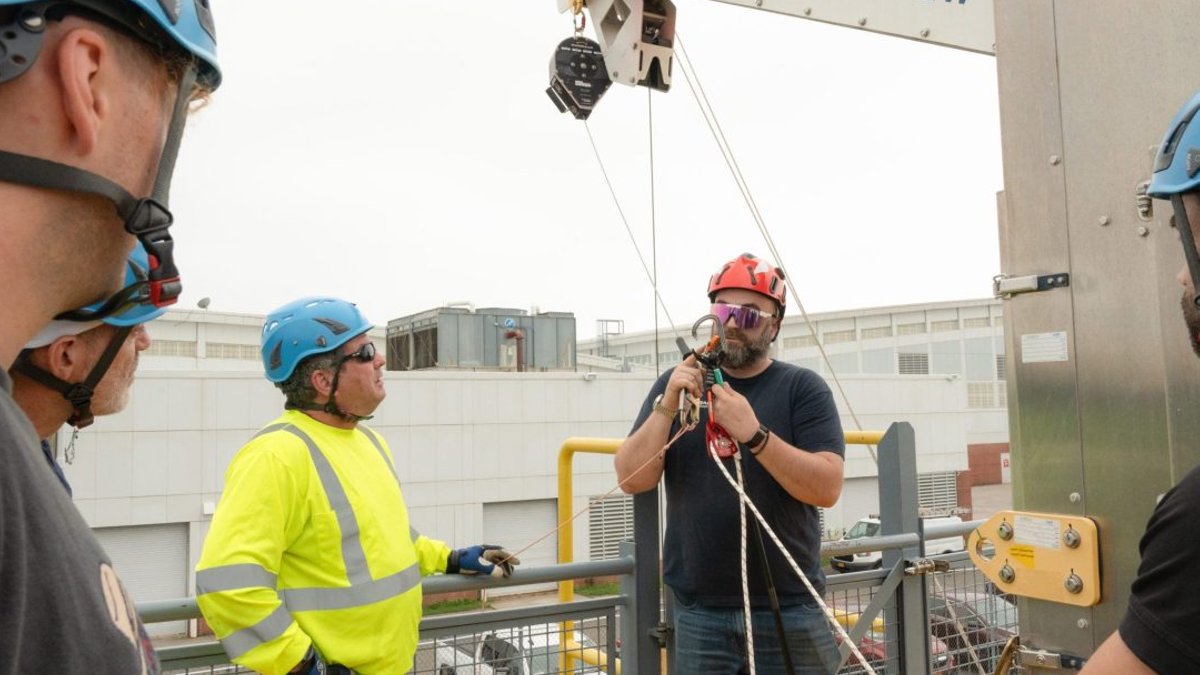
Offshore wind job training programs designed for rapid industry growth now face a sudden slowdown, a shift that former Navy sailor William “Billy” Bishop experiences directly as he works on the Sunrise Wind project off Long Island’s coast. A former union laborer from Local 1298 on Long Island, Bishop jumped at the chance to work on the water again when he learned two years ago about job opportunities on offshore wind construction projects. The training infrastructure built to meet ambitious federal targets now struggles to adapt as project approvals stall and investor confidence wavers.
Federal ambitions and training investments
The Biden administration’s 2021 commitment to 30 gigawatts of offshore wind capacity by 2030 triggered a nationwide push to prepare 77,000 workers for roles in construction, grid integration, operations, and component manufacturing. To address this need, the National Offshore Wind Training Center launched as a collaboration between Suffolk County Community College, the Long Island Federation of Labor, and wind developer Ørsted.
The initiative provides safety certifications, apprenticeships, and advanced degree programs to bridge the anticipated labor shortage. Bishop completed his certification through the center before joining a wind farm near Rhode Island for a season, where he worked on Revolution Wind. Now he’s doing structural inspections and maintenance on Sunrise Wind, conducting critical work on turbines still under construction. His experience reflects the broader tension between training pipelines and the industry’s uncertain trajectory.
Read Also: Treasury Proposal Threatens Tax-Exempt Status of Private Colleges Using Race
After earning his safety certification—required for all offshore wind workers—Bishop worked on a wind farm near Rhode Island before moving to Sunrise Wind. Bishop says he would definitely do this work forever, but he has seen contracts fall through nonstop in America since getting the job. “This might be the last one for a while,” he says. The domestic offshore wind industry remains in its infancy, with the first commercial-scale wind farm off Long Island only beginning to deliver power in December 2023. Despite the early-stage growth, a March 2024 Department of Energy report warned of a massive deficit of qualified workers by 2030, showing the urgency of the training efforts.
Policy reversals disrupt progress
When Donald Trump assumed office in January 2025, his administration immediately issued a “wind order” halting all new offshore lease and permit approvals. Later that year, the government issued emergency “stop work” orders on the five offshore wind projects under construction, arguing that they raised national security concerns. Both the stop work orders and the wind order were eventually overturned in federal courts. But the Trump administration’s war on offshore wind continued on other fronts. The government rolled back renewable energy tax credits, which it labeled “market distorting subsidies for unreliable, foreign controlled energy sources,” and rescinded hundreds of millions in grants earmarked for offshore wind and related projects.
Meanwhile, the administration has tried to revoke existing permits for offshore wind and slow-walk permitting reviews for new wind projects. Earlier this year, the administration started paying wind energy developers to abandon their offshore leases. The combined effects have dimmed offshore wind’s near-term prospects, leaving the U.S. with about 6 gigawatts of offshore wind capacity—far below the 30 gigawatts the prior administration had approved. No new offshore wind farms have broken ground since he left office.
Training programs respond by scaling back enrollment and pivoting to skills applicable across energy sectors. For example, Stony Brook University’s undergraduates now focus on high-voltage direct-current wiring, a skill relevant to both offshore wind and large-scale solar transmission. The class was one of several started in 2024 on State University of New York campuses as part of an effort called the Offshore Wind Training Institute, funded with $20 million from the state and the SUNY system. The curriculum now emphasizes adaptability, ensuring workers can transition if offshore wind remains stalled.
Read Also: South Korea tightens university controls on sensitive tech research
Workers adapt to stalled projects
Union leaders report that pile-driving specialists trained for projects like Vineyard Wind 1 are now exploring overseas opportunities as domestic work halts. John Dunderdale, business manager for the pile-drivers’ union, notes that while key offshore contracts remain frozen, the trained workforce could support other infrastructure needs. Dunderdale says the skills are still valuable, but the immediate demand has collapsed. These workers, who underwent heavy-lift training for massive offshore piles weighing up to 1,800 tons, had been preparing for New England Wind and SouthCoast Wind projects, both now on indefinite hold.
Enrollment at the training center persists, though a growing portion consists of workers renewing two-year certifications rather than new participants. Bishop, who expects to finish his assignment at Sunrise Wind in 2027, plans to shift to onshore construction unless offshore wind revives. His decision reflects the precarious balance between specialized training and an industry caught between political shifts and economic realities. Meanwhile, training programs like Stony Brook’s “A Taste of the Trades” have expanded their focus beyond offshore wind to include microgrid development and electric grid operations, recognizing the broader demand for energy sector skills.
Contact editor Caroline Preston at 212-870-8965, via Signal at CarolineP.83 or on email at [email protected].





Leave a Reply